|
15 October 2011
QUOTATION OF A DECADE:
TONY BLAIR HAS BEEN LAUGHING ALL HIS WAY TO THE WEST BANK.
COUNT VON DISCOUNT:
A nobly-titled European official who visited New York officially to attend the U.N. General Debate spent his last day looking for shopping outlets.
Upon hearing that a fashionable European designer had placed new cut-priced items at Target, he tried to make it to New Jersey or Long Island
stores; but no official cars were provided and public transport was simply not considered. A determined visit to Manhattan's Century 21 was
disappointing as its downtown and newly-opened uptown locations were closed for inventory. What's a financially-challenged Count to do? Pay
regular price? From his own pocket?
JUNG:
During a dinner at the White House by President Obama for Korea's visiting President Lee Myung, there was repeated reference to a Korean
qualification known as "jung." Both Presidents and our U.N. Secretary General Ban Ki-moon plus their wives shared table number 12 and talked of
"jung shin yuk," which reflects mental strength and confident spirit; "jung do" about doing the right thing; "jung shin sooyang" on strengthened
mind and generous spirit; and "chung myung kwon," a variation on evolving your body and mind. Obviously, all the distinguished interlocutors
flattered one another about their obvious "jung" or "chung" depending on how many toasts you made. Something to think about when approaching your
useful Korean contacts at U.N. Headquarters in New York.
HERVE'S TRANSPORT:
When he was Deputy Permanent Representation of France with Ambassador Alain Dejamet, Herve Ladsous had an official mission car paid by his
government. Now that he joined the U.N. Secretariat as its new Under-Secretary General for Peacekeeping, he has to manage his own way. Either he buys
a car with a different diplomatic plate and a special parking rate at the U.N. garage, or he uses public transport. Until very recently, he was
spotted taking the "Select" uptown First Avenue bus. Ambassador Ladsous was known to be a people's person -- confident, yet very pleasant and
easy-going. He was also reported as a good manager at the French mission and at the Quai d'Orsay in Paris. Let's hope he keeps it up in his
new New York assignment.
RUBBER BALL:
During dinner at the White House Thursday 13 October, Korea's President Lee Myung-bak recounted a story from his childhood. As a very poor child
in a small town, one of his dreams was to get blue jeans. When he heard that an American aid group was visiting the area, he waited in line and then
demanded the jeans. An American woman sized him up and told him he was too young to have any of their jeans. When he insisted, she looked around,
found her mobile closet, then handed him a rubber ball. "A rubber ball was all I got from the U.S.," he announced, adding immediately that his
country got a great deal through U.S. financial support and protective military presence. He spoke in Korean. By the time the interpretation in
English was over, it was time to make a toast. No one had time to ponder whether there was any subtle message involved.
REPLACING WILLIAM:
As Special Representative in Lebanon, Michael Williams has already left his post, and avid competition for the post is in full force. Spain's former
Minister of Foreign Affairs, Miguel Ángel Moratinos, who had served as European Representative in the region, is trying so hard that it most likely
ruined his chances. Both Lebanon's President and Prime Minister know him well; one of them may have put in a word on his behalf during the General
Debate visit. A main drawback is that there is already a senior U.N. official in Lebanon, UNIFIL Commander General Asarta, who is Spanish.
Having two main U.N. officials of the same nationality in the same country is usually avoided. Another competitor is a former Norwegian ambassador to
Lebanon. But then again, another senior Norwegian, Terje Roed Larsen, is still the Secretary General's Representative in following up resolution 1559
on Lebanon; it would have been awkward if another Norwegian is following resolution 1701! Unless, of course, plans are underway to ease Larsen out.
There remains Jean-Daniel Roche, Switzerland's Special Envoy for the Middle East. Discreet and steady, he may end up having the upper hand. That is,
if Finland -- a major contributor to U.N. Development projects in the region and to Peacekeeping -- does not push hard enough for its own candidate.
LIMITED ENTRY:
Monday 26 October as the Security Council was about to have its first look at the Palestine full membership request, dual interest diplomat
Terje Roed (Herring) Larsen approached the U.N. entrance on 45th Street. There were three gates there: one for senior delegates, who went straight
through; a second one for other delegates who had to go through the General Assembly main hall, and a third for other visitors with updated passes.
Larsen, who has conflicting interests in running a fundraising International Peace Institute while overseeing the implementation of U.N. resolution
on Lebanon, was stopped by a guard from entering the VIP gate. A pompous young assistant tried to brag about the importance of his boss to no avail. They
had to enter through the second. Is it a symbolic -- however unintended -- indication that the man who had totally controlled U.N. handling of the
Middle East under Secretary General Annan and the first term of Ban Ki-moon is losing his formerly uncontested status? Is Ban Ki-moon finally
preparing to get rid of him? Did the Arab Spring prepare grounds for dumping Larsen?
LUIS MARIA GOMEZ: AN EXCEPTIONAL INTERNATIONALIST:
Whether as U.N. Under-Secretary General, U.N. D.P. Deputy Administrator, or any other assignment he took, there was no mistaking the obvious fact
that Luis Maria Gomez was a dynamic leader, a people's person, and an unflinching believer in the role of the United Nations in today's changeable
world. Whether as a friend, colleague, or adversary, he came across as a man of courage and determination. He listened as attentively as he argued and
gave as much as he received. Particularly as Officer-in-charge of the Department of Administration and Management, he took creative initiative to open
the process and establish effective partnerships between the Secretariat and delegations, particularly members of the influential Advisory Committee
on Administrative and Financial Questions and the General Assembly's Fifth Committee. When he moved to UNDP, he strived to keep channels open between
key colleagues within the Secretariat and the Programmes, initiating a series of regular meetings which prepared grounds for joint representation in
the field. After his retirement, he moved South to his beloved Argentina where he continued to follow-up on events closely, sending advice and
comments to colleagues and friends. He passed away in July. An exceptional man with exceptional talent and unflinching commitment. May his soul rest
in peace.
YOUR ENVOY:
The U.N. Special Envoy group is so out of control that it is not clear by now whether designer Giorgio Armani still is -- or ever was -- one of
them. He once carried some title about humanitarian assistance to Afghanistan (when war there was fashionable in its own way!). Anyway Blue Eyes
(or are they contact lenses?!) has recently bought the Greek Island of Skorpios, formerly famous property of Greek magnate Aristotle Onassis (late
husband of Jacqueline Kennedy Onassis). Granddaughter Atina sold it to him for a mere $190 million. Valerie Amos take note.
SECRETARY GENERAL APPLAUDS THREE INSPIRATIONAL WOMEN:
"The 2011 Nobel Peace Prize honours three inspirational women of uncommon courage, strength and commitment - Liberian President Ellen Johnson
Sirleaf and social activists Tawakkul Karman of Yemen and Leymah Gbowee of Liberia. With this decision, the Norwegian Nobel Committee sends a clear
message: women count for peace. It is a testament to the power of the human spirit and underscores a fundamental principle of the United Nations
Charter: the vital role of women in the advancement of peace and security, development and human rights. Across the world, we recognize that women
are the cornerstone of family and community. Overwhelmingly they are the educators, the health care providers, the weavers of our social fabric.
Throughout North Africa, the Middle East and beyond, we hear the voices of women calling for justice and democracy. As this prize attests, they are
increasingly taking long-overdue leadership - as economic actors; political activists; local, national and even global decision-makers. Today, as we
salute these three remarkable leaders, we at the United Nations reaffirm our determination to advance the cause of women across the full spectrum of
our work. That is why we created a dynamic new UN agency, UN Women - to drive this change. The eradication of sexual violence in conflict and the
full inclusion of women in building peace and democracy is not an option. It is a necessity for creating a better future for all of the world's
people.
CONFUSED ON CHILDREN:
The confusion started even before the meeting. "Special Representative of the Secretary General for Children and Armed Conflict," Ms. Radhika
Coomaraswamy, had issued invitations for a panel discussion on Monday 10 October at 1:00pm. Those who arrived in time had to hang around for a while --
like half an hour -- until another group, very hesitantly and slowly, left the conference room. It seemed like a Francophone African event as a couple
of diplomats at the door kept repeating "Merci pour etre venue" to those they were unclear whether they were coming or going. While Conference Room
7 of the North Lawn Building had been indicated, arrivals were ushered to Conference Room 6. Although the Permanent Representative of Sierra Leone
Sheikou M. Touray was billed to introduce a former child soldier from his country, another junior member of that mission took central seat; shouting
around as if he owned the event. Our usually gracious Radhika shuffled at a moderating chair, unsure when to start, nervously toying with her very thin
yet chic eyeglasses. Incoming participants were looking for seats, but no one from the organizers seemed interested. It was each for himself -- or,
actually herself because they were mostly dedicated enthusiastic women. The statements proved to be a disappointment, almost like acting out of a
scripted scenario. Ms. Coomaraswamy seemed to be going along with the confused flow, driving some observers to wonder about the fate of all these
children in areas of conflict. The only preparation she seemed to have made for the occasion was to cut her hair!
GRILL JILL:
N.Y. Times new Chief Editor Jill Abramson, who replaced Bill Keller, is initiating a new internal management practice. In an open
meeting with the paper's staffers, she would invite them to raise any issue and ask any question during an open session at the Times Auditorium.
The first "Grill Jill" will start Friday 14 October from 11:00am to 2:30pm. Those who won't be able to attend were encouraged to send email. You
want the address? It's "grilljill@nytimes.com". Whether you get an answer or not depends on whether you do work at the Gray Lady or are just a
curious blogger.
RABBANI:
The recent assassination of former Afghanistan President Burhanuddin Rabbani, who headed reconciliation talks, raised questions on the motives
and the identity of the assassins and their facilitators. The ethnic Tajik leader was deeply involved in secret talks with varied factions, including
Taliban leaders. Weeks before his murder, Rabbani attended a meeting in Tehran, upon the invitation of the Iranian government, where he met -- among
others -- Lebanon Hezbollah Deputy leader Sheikh Naim-Qassem. Iran, like Rabbani, had fought the Taliban, has a joint border with Afghanistan, and a
predominant "Hazara" (Shiite) population in Afghanistan's Eastern region. At the current confused mixture of allies and adversaries, any
speculation would make sense; or no sense at all.
DON'T HUSSLE:
From Rudyard Kipling:
"Now, it is not good for the Christian's health
To hustle the Aryan brown
For the Christian riles and the Aryan smiles
And it weareth the Christian down
And the end of the fight
Is a tombstone white
With the name of the late deceased
And the epitaph Reads: "A fool lies here
who tried to hustle the east."
TOKAYEV'S PROGRESS:
Kassym-Jomart Tokayev, new Director General at the U.N. Geneva Office, was in New York for basic meetings relating to the opening of the General
Assembly and to attend to relevant business. An experienced diplomat and intellectual who served as Kazakhstan Minister of Foreign Affairs, and
Chairman of its Parliament, as well as author of several books, Under-Secretary General Tokayev impressed his counterparts with his swift grasp of
the issues facing the U.N. European office and his capable handling of agenda items, like those in the First Committee, including disarmament and the
non-proliferation of nuclear weapons. Incidentally, Kazakhstan was the first member state to give up its already acquired nuclear capacity. Insiders
aware of the background of lobbying for the Geneva post, and impressed by Mr. Tokayev's progress in that new assignment, expressed appreciation to
Secretary General Ban Ki-moon for the courage it took to bypass politically-backed candidates from influential industrialized European countries
(for example, Germany), to designate such a qualified Eurasian representative.
50 YEARS LATER:
It's time again for the election of five new non-Permanent members of the Security Council. For years, nominations were settled within regional
groups. But -- with changing times -- and changing U.N., several groups end up competing in public. For example, to replace Lebanon (Asia), Pakistan
is facing a challenge from Kyrgyzstan; to replace Bosnia (Eastern Europe), Hungary, Slovenia, and Azerbaijan. Two Arab countries, Morocco, and
Mauritania, are trying to replace Nigeria (Africa). Those with institutional memory recall that both were one and the same country. It will be
deeply ironic if the vote takes place on 27 October -- it's the exact date when Mauritania split in 1961 -- 50 years later.
MONA'S SPRING?:
Our dynamic -- and charming -- Legal Eagle Mona Khalil has covered both U.N. Headquarters, regional and field assignments. Having returned to
New York from Vienna about a year ago, she may now be sent on a special assignment, perhaps her most challenging one. She is most likely to join
Special Representative Ian Martin on a forthcoming mission to Libya. Considering the uncertain political outcome even amongst the National Council
and the undetermined fate of "El Colonel," together with the ambiguity of the U.N. role, Mona's participation will certainly require all of her
courage and dedication -- as well as enlightened determination to do what's right. At least more than most of those staff members watching with
distanced binoculars, Mona will be an active observer of the Arab Spring. Good luck.
PROTOCOL/SECURITY:
While visiting heads of state and governments get all the attention during the U.N. Assembly General Debate, the backbone of the annual event
are hard-working staff of Protocol and Security. Every speaker has to be properly introduced and escorted in and out of the hall. One hundred and
ninety-three delegates have to be arranged entry passes and attendance facilities for their participating members. Every minute of every day
carries with it a political success -- which would be credited elsewhere if successful; or controversy, which would be placed either on
Protocol or Security. Their familiar faces show up -- quietly yet effectively -- in the entrances and exits, as well in the corridors of meeting
places. Most of the pressure comes before the Assembly starts -- when talented staff like Wai Tak Chua spend most of their August to early September
evenings at the office while everyone else was on holiday. While Najla Shawki, who just retired and was truly missed, particularly by her colleagues
who gave her a fond farewell, others like Anna and, of course, Protocol Chief Desmond Parker, maintain the ever-changing momentum. In expressing
appreciation to staff who served the Debate, Secretary General Ban Ki-moon made a special mention of both Protocol and Security. It was also
heartening to see some retired colleagues like Joyce Sulahian, respond to the call of duty and return to serve during the current General Assembly
Session.
RE-INCARNATION:
Ahmed Chalabi, whose name was closely linked with the U.S. invasion of Iraq, reappeared recently in Beirut under another venture. During a human
rights banner about violations in Bahrain, a number of Lebanese participants like former Prime Minister Selim Hoss were not aware that the "Chairman
of the Public Conference to Support Bahrain" was none other than the same Ahmed Chalabi. They had thought it was a coincidence of similarity. When
he took the podium, there were group withdrawals and shouts about "those who rode in American tanks." Chalabi, who now reportedly works closely
with Iran, had told "Al-Hayat" in an interview a year earlier, that he had used the U.S. in 2006 for his political purpose; not the other way round.
ZORO TOLERANCE:
Despite repeated claims about zero tolerance of sexual harassment accusations, there is one prominent case which remains unresolved despite
three years of deliberations. Whispers among staff indicate that the man is untouchable, initially because he was close to the former head of
Department and recently because of his closeness to the Chef de Tandoori and the influence of his mission, a non-permanent Security Council member.
The person supposedly representing the staff has already given up the case after one other member got cold feet, most likely after being forewarned.
Briefly, the man in question has been given additional, more important liaison functions by the new director who steps over those under him but bows to
those above. With such "zoro tolerance," the man in question -- who is married -- has been seen repeatedly with another woman in his section outside
the U.N. -- like near Central Park on Sundays. Perhaps the Public Enquiries Unit would send a standard circular acknowledging receipt of the initial
complaint and indicating it was under serious consideration. Or perhaps, Ramu could lend a hand -- just a hand!
FINI?:
When Cardinal Bechara Rai, the new Patriarch of Maronite Christians -- a majority in Mount Lebanon -- made his traditional visit to Paris early
September, he was told empathetically by President Sarkozy that Syrian President Bashar Assad was over. "Il est fini, fini" he repeated. The
cautious and very well-informed Patriarch enquired, with a doubting smile, from France's similarly well-informed Minister of Foreign Affairs, Alain
Juppe, whether his President's predictions were definite conclusions by the French establishment. The answer was not that certain. The army was still
with Assad, as well as the whole governmental structure, together with a sizeable part of the metropolitan population. "Pas fini" was Juppe's
conclusion.
CAREFUL:
Retired colleagues in Florida may not be aware of a new law in their Sunshine state: no sex with animals beyond October. A case was raised after
a Floridian wrote a popular book about his affair with a dolphin. He claimed the dolphin started it by flapping its wings at him and slurring its
teeth. Friendly advice: don't try it in Orlando. Shamu the whale may not be far behind.
SAIF'S PARTNER:
Apparently events in Libya are finally having a financial impact on the Financial Times. The 234 million English Pounds invested by Colonel
Qaddafi's regime in the Pearson Group -- that publishes our favourite daily -- may be showing some strain after all. Reporters have recently been
advised not to submit any job-related expense claims, at least for the next six months. Stick to basic essentials, media toilers were told. And, of
course, no taxis; try public transport instead. That's a long way from three years ago, when a custom-designed new chair had to be specially
ordered for a new editor. Where have you gone, SAIF?
R.E.M.:
"That's me in the corner. That's me in the spotlight, losing my religion" was a popular version of a song by a popular R&B group of the Nineties.
R.E.M. was a Yuppie favourite, a code word of music enjoyment among the "it" crowds in metropolis gatherings in New York, L.A., and San Francisco.
This month the group decided to call it quits. No more jazzing at "Everybody Hurts." No more "What's the Frequency, Kenneth?" which was once used
when approaching CBS top anchor Dan Rather near his Upper East Side home. The group has now disbanded. "It's the End of the World As We Know It. And
I feel fine"!
DEJA VUE:
Since Philippa "Pippa" Middleton's tightly wrapped behind was flagged around the world during the royal wedding of her sister Kate, she has become
famous for being famous. That meant that aspiring paparazzi would hang around her favourite party to pick up whatever cleavage they could sell to
gossip magazines. Either because she was fired up or merely exhausted, "Pippa" somehow lifted her short skirt for a second, but long enough for
a flashy photo which did not get its adequate reward mainly because the world had already seen a more adequate package months before.
DEJA VOUX:
When France's President Sarkozy spoke at the first day of the U.N. General Debate 21 September, he apparently expected the Secretary General
to be personally present on the upper podium, as was the case with the three previous speakers: Presidents of Brazil, the U.S., and the Emir of
Qatar. With his renown attention to personal detail -- not to mention a big ego -- he would not have let it pass when he concluded. As Protocol was
about to escort him through the usual side entrance/exit and the podium officials came down to shake hands, he expressed himself quite bluntly to
the occupant of the Secretariat chair, the perplexed Deputy Secretary General Asha-Rose Migiro, who soldiered on with a vague clueless smile.
DEJA?:
Christine Lagarde, the new chief of IMF who replaced DSK after the infamous New York sexual scandal, is known for her very politically-correct
language, her thorough understanding of American culture, having worked for years as head of a Chicago firm, and -- of course -- her devotion to
French couturiers like Chanel (jackets), Hermes (scarf and hand bag), and Louboutin (shoes). Several of her immediate staff were puzzled therefore
when she was having a press interview and responded to the "voice test" by counting 1,2,3, then turning to the young man on an open microphone to
tell him with a smile: "You really are good looking"!
DEAD RIGHT:
During a television debate among U.S. Republican Presidential hopefuls -- mostly right-wing, there was an obvious competition to display very
conservative financial credentials. That meant repeated -- though clearly clueless -- references to the "Keynesian" financial theories. Most likely,
politicians like Michele Bachmann, Sarah Palin, and Rick Perry may not have known even the full name of British economist John Maynard Keynes. Perhaps
Mitt Romney did, but because of his keen desire to appear like an ordinary man of the people, he avoided appearing like an intellectual show-off.
Anyway, towards the end of the debate, Texas Governor Perry took the floor to surprise everyone with the discovery that Mr. Keynes was dead. Puzzled
participants fell silent. It reminded us of one of Professor Keynes most famous predictions: "In the long run, we are all dead."
STAND UP:
"First they ignore you. Then they ridicule you. Then they fight you. Then you win."
-- Mahatma Mohandes Ghandi
WAKE UP:
"Be a Columbus to whole new continents and worlds within you, opening new channels, not of trade but of thought."
-- Henry David Thoreau
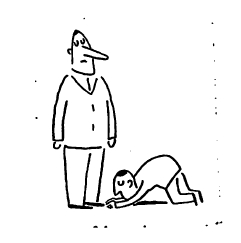
NEO-PEACEKEEPERS:

(Title ours; cartoon in Private Eye)
SPEECH:
"Goodbye."
-- The entire speech by U.S. President Calvin Coolidge
HERRRR:
|


